


England’s new local plan-making system is beginning to reshape how local planning authorities prepare emerging Local Plans. The new framework introduces a more structured 30-month process, with clearer stages for plan preparation, evidence gathering, consultation, gateway assessments, examination and adoption.
Troy Planning + Design is already engaging with this new system through our work with parish councils and other stakeholders responding to early Local Plan scoping consultations. Recent work has included engagement with emerging plan preparation in areas including Three Rivers District, Stroud District and Wiltshire, among others.
A key early step is the publication of a Notice of Intention to Commence Local Plan preparation under Regulation 19 of the Town and Country Planning (Local Planning) (England) Regulations 2026. This signals the start of a more disciplined plan-making process and gives communities and stakeholders an important opportunity to understand when and how they can engage.
The new system is intended to make plan-making faster, more structured, more transparent and more digital. Government guidance confirms that local planning authorities must prepare a single local plan and should adopt it within 30 months. The process includes a more clearly sequenced set of stages, including notice of plan-making, scoping consultation, three gateway stages, examination and adoption.
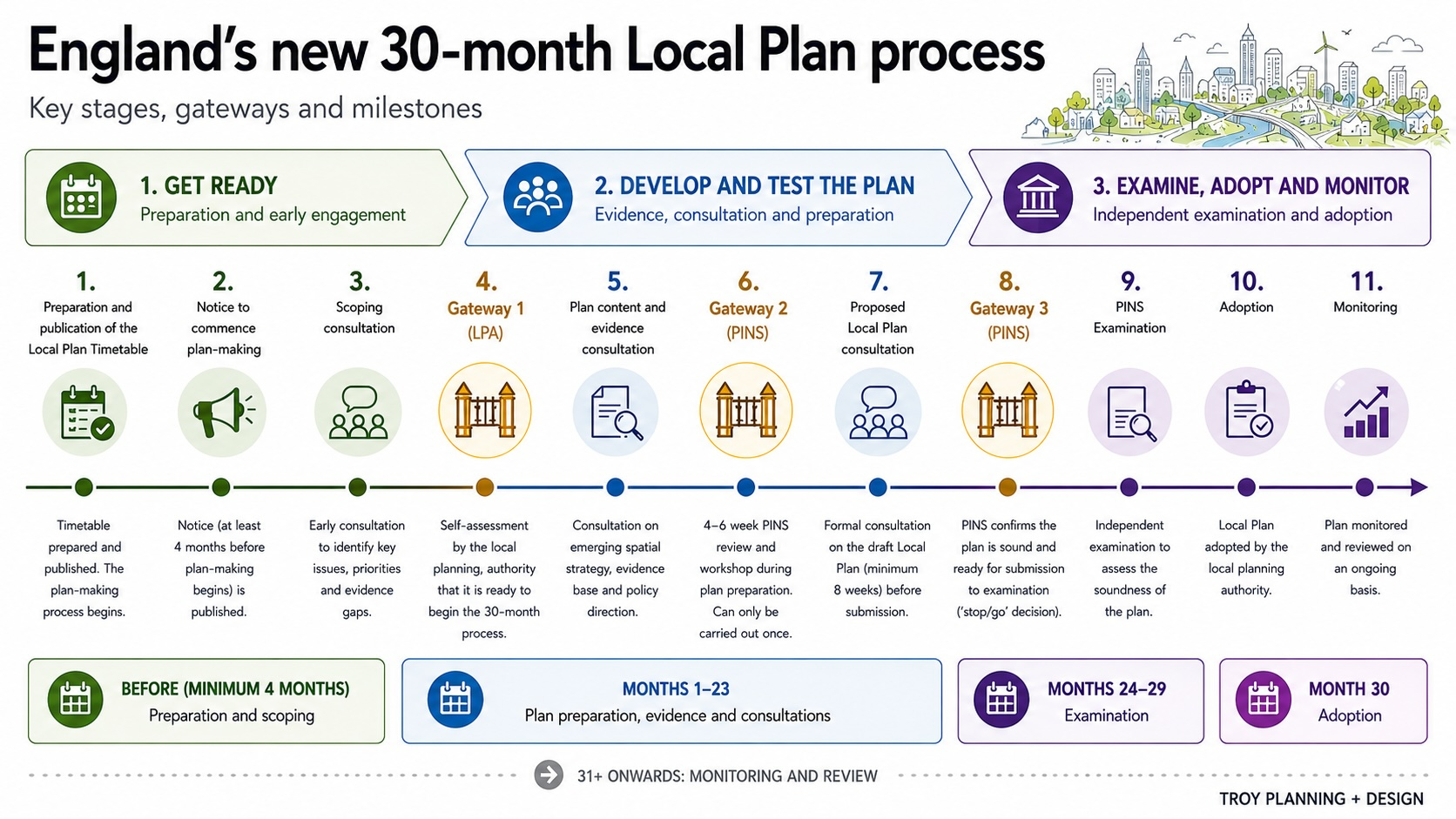
Our interpretation of England’s new 30-month Local Plan-making process
As the new system takes effect, local planning authorities are taking different approaches to early-stage consultation. Many are adopting a broad scoping approach, inviting comments on the key issues likely to shape the Local Plan, including housing need, spatial strategy, infrastructure, design, climate change, the natural and historic environment, and community engagement.
Our representations have focused on the need for emerging Local Plans to be genuinely plan-led, evidence-led and infrastructure-led. Housing targets arising from the revised standard method should not, by themselves, drive the allocation of unsuitable or unsustainable sites. Growth should be directed to locations supported by robust evidence, infrastructure capacity, environmental sensitivity, deliverability and a clear understanding of local character.
Early-stage Local Plan consultations are therefore an important opportunity for communities and stakeholders to influence the direction of plan-making before spatial strategies and site allocations become more settled.
Lessons from the Planning Inspectorate
Troy Planning + Design also recently attended a Planning Inspectorate webinar on the new 30-month Local Plan framework. A key message was that, although the process is changing, the fundamentals of good plan-making remain the same: robust evidence, effective engagement, a clear and justified spatial strategy, and a plan capable of being found sound at examination.
Gateway 2 is expected to be one of the most important stages in the new process. It provides an opportunity for the Planning Inspectorate to act as a “critical friend” during plan preparation, before the plan is finalised for submission. The timing of Gateway 2 will therefore be critical: plans will need to be sufficiently developed to allow meaningful review, while still capable of being refined.
Gateway 3 will then act as the final stop/go check before submission for examination. If the plan passes Gateway 3, it must be submitted for examination shortly afterwards. If it does not, the authority will need to address the issues identified before proceeding.
The examination stage is also expected to be more tightly managed. This means the quality of the submitted plan, the strength of the evidence base and the way consultation responses have been addressed will matter more than ever.
The new system reinforces the importance of early and meaningful engagement. For parish councils, community groups and other stakeholders, the scoping stage is not simply a preliminary exercise. It is a real opportunity to shape the issues, evidence and choices that will guide the emerging Local Plan.
Through our current Local Plan work, Troy Planning + Design will continue to monitor how local planning authorities navigate the new system in practice. The new framework creates a more disciplined and transparent process, but its success will depend on how effectively authorities, communities, stakeholders and the Planning Inspectorate work together to plan early, engage meaningfully, manage evidence and resolve issues before examination.
Need support with a Local Plan consultation?
Troy Planning + Design supports parish councils, community groups and other stakeholders with Local Plan representations, evidence reviews, spatial strategy advice and engagement with the new plan-making system.
If you would like to discuss how we can help, please contact us at [email protected].